Introduction to the Observatory
Observation Records

Field Notebooks, Meteorological Observation Logbooks,
and Recording Charts
Records of meteorological observations conducted since the establishment of the Seikei Meteorological Observatory in 1926 are stored in the Meteorological Observation Room in the form of field notebooks, meteorological observation logbooks, and similar documents. Additionally, the recording charts displaying self-recorded data for temperature, pressure, and relative humidity are also preserved as they were. Here, we introduce some of these items.
Field Notebooks
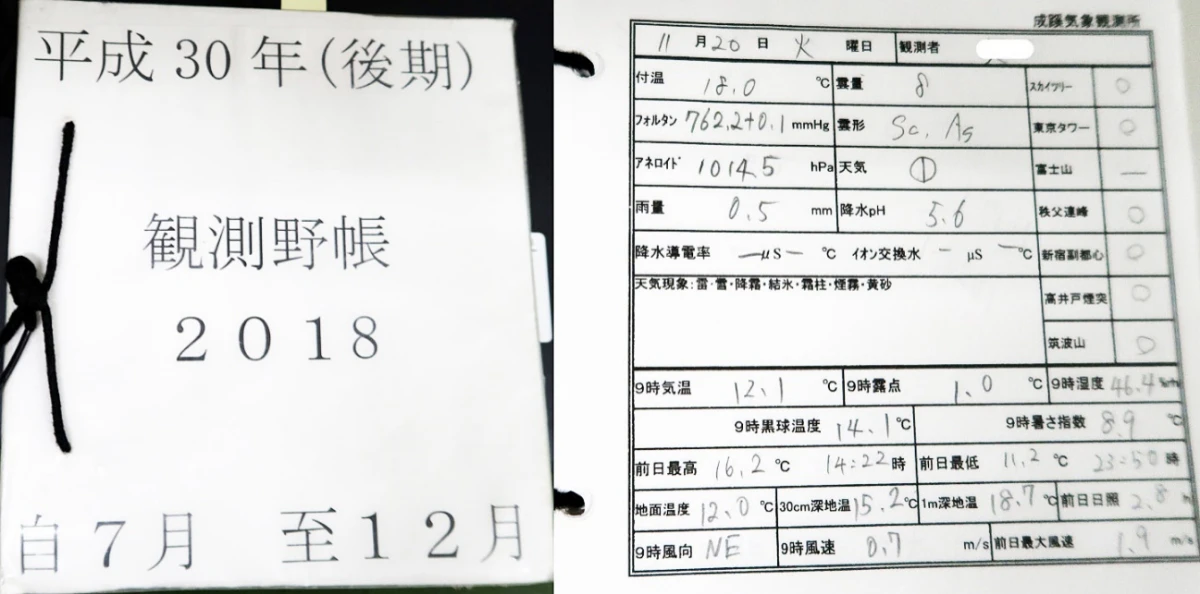
The notebook carried during daily fixed-time (currently 9:00 AM) meteorological observations and used to handwrite recorded data is called a “Field Notebook.” The photo below shows one such example.
Meteorological Observation Logbooks
The Seikei Meteorological Observatory has compiled daily weather observation data on a monthly basis to create a "Meteorological Observation Logbook" for each year. Since 1958, the contents of the Meteorological Observation Logbook have been printed and bound as the “Meteorological Observatory Report,” published annually.
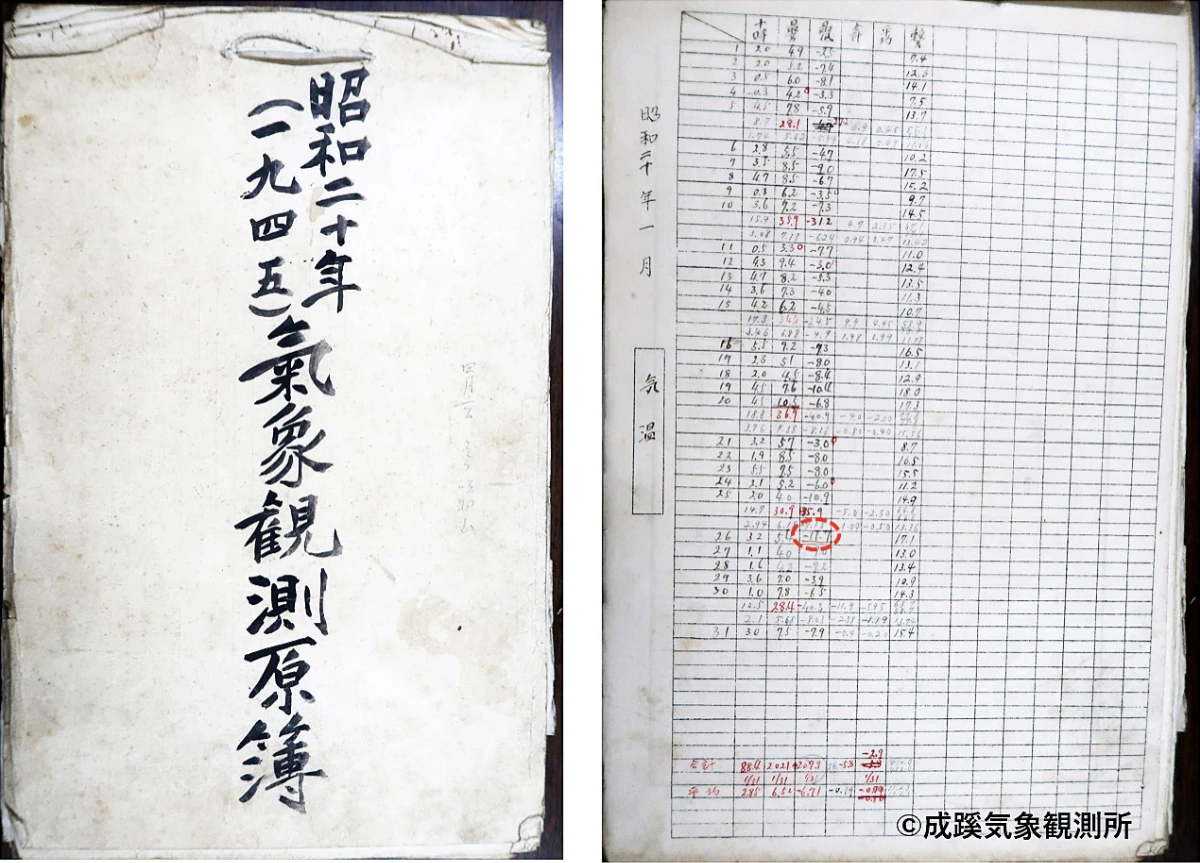
At the Seikei Meteorological Observatory, meteorological observations continued without interruption even under the air raids of the Pacific War. The Meteorological Observation Logbook shown below contains records from 1945, the year the war ended. The right-hand page displays the results for January, and on the date enclosed by the red dashed line, a minimum temperature of –11.7°C was recorded. January 1945 was extremely cold, with 22 days of the daily minimum temperature falling below –5.0°C. For comparison, in January 2023, there was only one such day.
Recording Charts
Since its establishment, the Seikei Meteorological Observatory has used various types of analog self-recording instruments. A self-recording instrument is a device in which a strip of recording paper—printed with a scale and wrapped around a cylindrical drum—captures data continuously through the inked tip of a pen. The drum rotates by means of a spring mechanism or by a motor powered by batteries. There are weekly and daily types, and the recording paper is replaced each time the drum completes a full rotation.
In the Stevenson screens at the observation field, self-recording instruments for temperature and relative humidity are installed, while a self-recording barometer is housed in the meteorological observation room. Digital automatic meteorological observation equipment was introduced in 1994, and observation data is now recorded down to the second. Prior to that, however, analog observations were mainly made once a day. For this reason, the recording charts containing continuous data for temperature, pressure, and relative humidity were invaluable for understanding temporal variations in weather conditions. Efforts are underway to digitize these using specialized software.
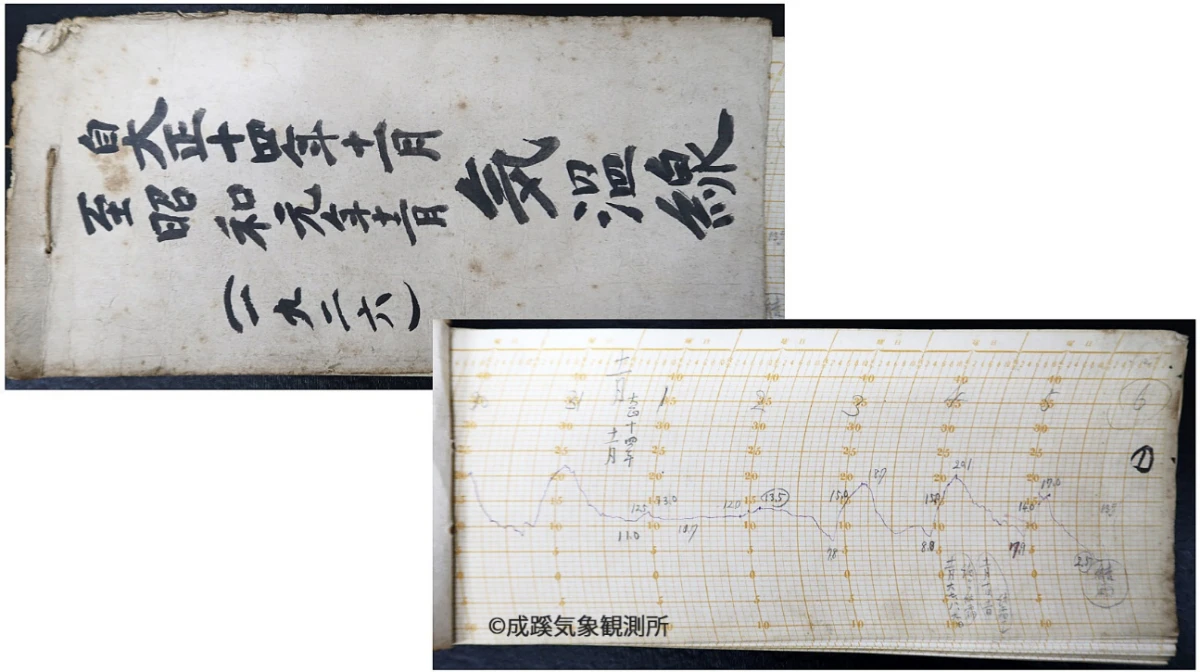
The following shows the recording chart paper from the weekly-winding self-recording thermometer from November 1926, when the observatory was established. It is preserved in a readable state even after nearly 100 years.